

PROTECO Strike-8 Sliding Gate Opener
PROTECO Strike-8 sliding gate motor with mechanism for gates up to 800 kg. Available without control panel and remote control. Includes: base and mounting materials, terminal switch activation plates, disengagement keys, installation instructions in Greek, etc. For gate weight up to 800kg.
Depending on your needs, you can add 1 to 5 remote controls with a panel, 4 to 7 meters of rack, and wired or reflector photocells.
General information about the PROTECO Strike-8 mechanism:
- For maximum gate leaf weight of 800kg
- Non-reversible, permanently lubricated mechanism
- Single-phase motor (230 VAC)
- Mechanism dimensions: 260x230x260 mm (LxWxH)
- Gate leaf speed: 10.5 m/min
- Motor absorbed power: 300 W
- Equipped with a key for disengagement (manual operation)
- Protection rating: IP44
- Gear type is Z12/module 4.
- Country of origin: Italy
- Warranty: 2 years

To order this product, call us at 210.555.0632 or buy it online from our eshop.
The PROTECO Strike-8 sliding garage door motor includes:
Initial set:
- PROTECO Strike-8 sliding garage door mechanism for an 800kg door.
- Mechanism mounting base with screws and anchors
- Manual release keys (2 pcs)
- Terminal switch activation plates
- Detailed instructions written in Greek
You can add:
- Control panel and ProfelmNet PSD-36T remote controls at 433.92 MHz from 1 to 5 pcs
- Metal rack from 4 to 7m (each piece is 1m long)
- Wired or wireless (with reflector) photocells
If you wish to add more remote controls, more meters of rack, or photocells, you can call us or order them separately from the set at the links below:
PROTECO Strike 8 Mechanism - Dimensions

Choosing a sliding garage door mechanism
- The weight of the sliding garage door. The PROTECO Strike-8 mechanism is suitable for doors weighing up to 800kg.
The 800kg door weight covers most cases of doors since an average gate weighs 50-60 kg/m. Particular attention should be paid to ensuring that the door operates smoothly in manual mode. This means testing the door's movement without the mechanism or with the mechanism in manual operation mode. If the door does not operate smoothly, it should be repaired. Otherwise, it will cause problems for the mechanism and there will be malfunctions.
Sliding garage door - Checks before mechanism installation
The most important check that needs to be done even before ordering the mechanism is to check if the door operates smoothly by hand. We open and close the door at a steady speed, approximately the same as it would have with the mechanism. If at any point the movement presents difficulty, there is a jolt, etc., the door must be repaired before the mechanism is installed.
The checks that need to be carried out in detail are:
- If the rail is straight without curves, bumps, or rust. It must also be properly secured to the ground.
- The door's wheels must be in good condition. They should not show signs of deformation or rust. Their movement must be trouble-free.
- Shortly before the door's closed position, check for door sway. If it moves violently back and forth, intervention is required to repair the door. Possible repair points include the door's material (excessively flexible), the position where the rollers are installed (they have a large gap with the door), or the roller mounting point is too flexible.
- The door must enter smoothly into the receptacle at the closed position. It must "lock in" so that it cannot be easily lifted with a crowbar.
- The open and closed positions of the door must be defined by mechanical stops. Under no circumstances should the door leaf be free to pass beyond the closed or open position.
Typical layout of a sliding garage door with a mechanism

In the sketch above, we observe a typical layout of a sliding garage door with a mechanism. Obviously, the main element of the construction is the door leaf, which can be made of aluminum, metal, or wood. A basic prerequisite is that it must be sturdy and rigid enough to move, while only touching the wheels and rollers without excessive swaying.
The door must have mechanical stops to define the closed and open positions. The mechanical stops define the door's travel.
The rollers are placed at such a point that they are in contact with the door leaf throughout its entire travel (from the fully open to the fully closed position). Essentially, the rollers keep the door perpendicular to the ground. A basic prerequisite is that they should not hinder the door's movement.
The door rests on the wheels which allow it to move. The movement takes place on the rail, which is shaped to work perfectly with the wheels. The wheels must be in good condition, without signs of deformation or rust. The rail must be properly supported on the ground, be straight, and show no bumps or deformations.
The motor is also placed at a point where it is always in contact with the door. The movement is transmitted to the door from the motor's gear. The rack, which is a toothed rail, is mounted on the door. The rack is the point of contact between the door and the motor, and through it, the movement is transmitted.
Photocells are the most important accessory for a sliding garage door with a mechanism. They prevent accidents and protect both users and their vehicles. They are installed at the door's opening and prevent the sliding door from closing if there is an obstacle in its path.
Another accessory for a sliding garage door (not shown in the sketch) is the warning lamp. It is placed in a prominent position to warn passing vehicles and pedestrians that the garage door is in operation. This is a particularly useful device when the garage door is near a busy road or when visibility is not optimal.
Wiring of the PROTECO Strike-8 sliding garage door mechanism

The wiring of sliding mechanisms is a process that usually requires specialized personnel.
- The mechanism requires a 3x1.5mm² or 3x2.5mm² cable if the distance of the automation installation point is far from the control panel. (It is advisable for the mechanism to be on a separate fuse in the control panel).
- Wired photocells require a 4×0.6mm² cable for the receiver and a 2×0.6mm² cable for the transmitter. We usually place the receiver close to the mechanism. If it is impossible to route a cable across for the photocells, we can install reflector photocells, which only require wiring from one side.
- The warning lamp requires 1×1.0 mm² or 2×1.0 mm² wiring. (can be added separately from the set)
- The key switch or simple push button requires 2×0.6mm² wiring. (can be added separately from the set)
All cables must be protected from the weather (inside conduits).
Remote controls for sliding mechanism ProfelmNet PSD-36T

The ProfelmNet PSD-36T remote control features 4 buttons to which we can configure 4 different mechanisms. It has a fixed 12-bit code at 433.92 MHz. It is easy to use, well-designed, and works perfectly with the Autotech S5060T control panel.
Control panel for sliding mechanisms PS3033
The PS-3033 is the new complete 110/230VAC automation for sliding door motors up to 1200watt. High specifications and functions. Accepts up to 300 remote controls.

Main functions:
- Features indicator LEDs for each activated function
- Features separate limit switches for the motor
- Features non-sparking relays for longer relay life
- Features a command for an external button
- Features an output for photocells with separate 24VAC power supply
- Brake selection capability for large and powerful motors
- Features adjustable motor force and separate adjustable slow-motion force
- Automatic motor direction change
- Accepts a 230VAC beacon with flash or permanent light selection up to 25W for 3 minutes
- Features Double automatic closing
- Travel time adjustment capability per second, from 1-180 seconds
- Features slow-motion operation selection during path closing
- Features anti-interference filters
- Temperature from -20°C - 60°C
- Box dimensions 111x82x30 mm, in a watertight ABS plastic box
Safety Photocells - Operation
Safety photocells are an economical but essential accessory for every type of garage door. They prevent accidents and do not require maintenance or any special care from the user.

Safety photocells consist of a transmitter and a receiver. The transmitter emits an infrared light beam, in the invisible spectrum, which is directed towards the receiver. When there is no obstacle interrupting the beam, the door operates normally. When, during the closing of the door, the beam is interrupted by an obstacle (vehicle, pedestrian, pet, etc.), the control panel instructs the mechanism to stop closing the door and begin the reverse movement (opening). If the beam is interrupted while the door is opening, it continues its course normally, while if it is open, it is not allowed to start closing.
If it is not possible to run cables for wired photocells, we can choose the solution of reflector photocells. These photocells require wiring only from one side of the door (the motor side), so they are easier to install. They are preferred in cases where the door and surrounding area have been completed without provision for wiring. They have a small surcharge compared to wired photocells but are a very good solution when wiring cannot be run. In the set, you can add either wired photocells or reflector photocells.
Wired photocells NOLOGO IR5001P / Zoom-Z2E
The NOLOGO IR5001P / Zoom-Z2E photocells are a reliable choice of wired photocells consisting of a transmitter and a receiver with a range of 20m. As wired photocells, they require wiring on both sides of the opening.
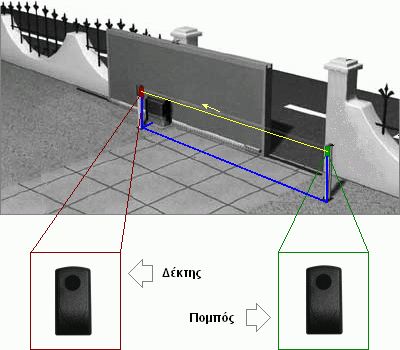
Technical characteristics of NOLOGO IR5001P / Zoom-Z2E photocells:
- Operating voltage: 12 or 24 V DC, 12 or 24 V AC
- Maximum operating distance: 20m
- Maximum contact current: 0.5 A at 48 V AC/DC
- Transmitter operating current: 25 mA
- Receiver operating current: 35 mA
- Interference rejection circuit from other light sources
- Auto focus
They are usually installed at a height of 50cm from the ground. They are simple to install and can prevent major damage and accidents. Their operation is trouble-free as they do not require maintenance, are not affected by weather conditions, and do not require any action from the user during their use.

Safety photocells with reflector Witt Sensoric RP25
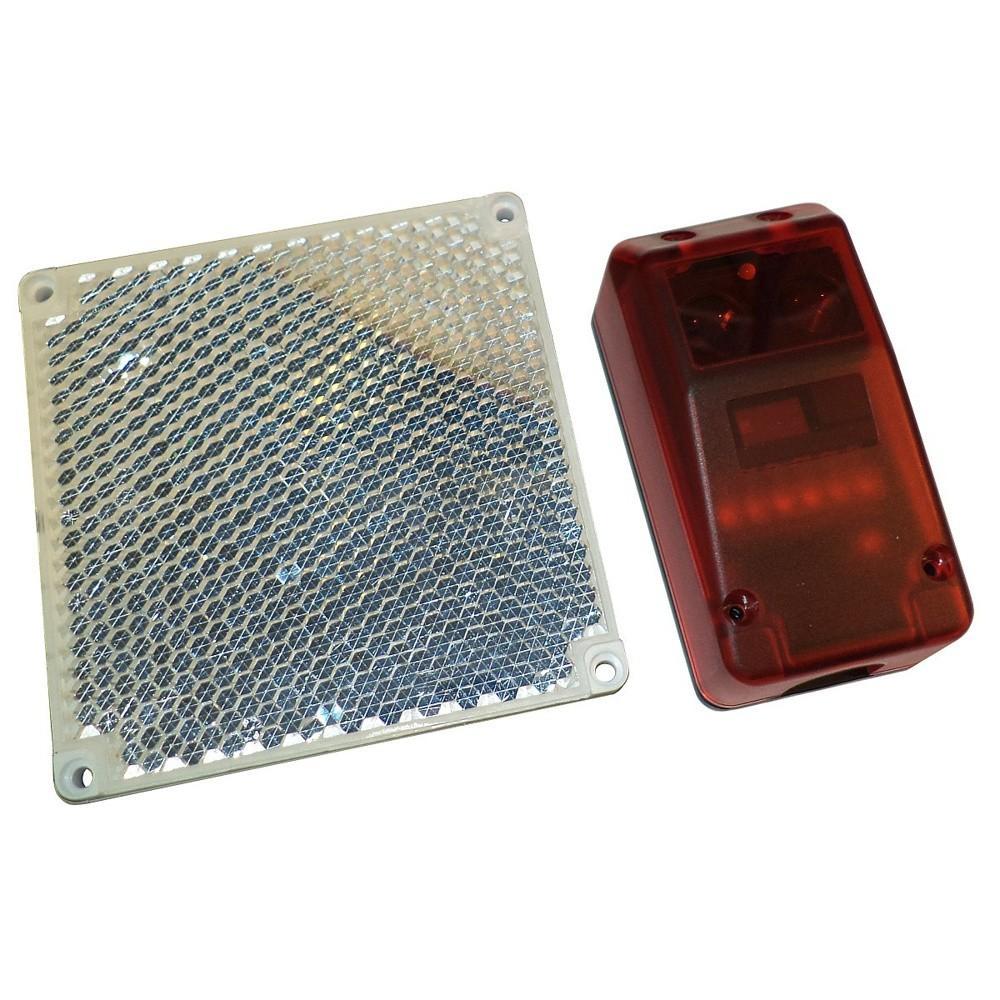
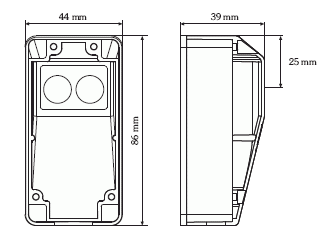
The biggest advantage of photocells with a reflector is that they only require wiring from one side where the transceiver is installed. The reflector is installed opposite. The reflector has dimensions of 10x10cm, while the dimensions of the transceiver are:
Characteristics of Witt Sensoric RP25 safety photocells with reflector:
- Convenient size and shape for both transceiver and reflector.
- Do not require batteries like other competing wireless photocells.
- Reliable operation even in harsh weather conditions (suitable for outdoor use).
- 15m range covering most sliding doors.
- Not interfered with by sunlight or other light sources as they operate with a polarized light filter. This means they can detect even reflective objects between the transceiver and the reflector, making them less likely to be fooled by a car's polished surface.
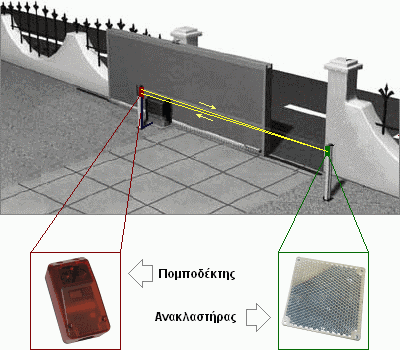
Technical specifications of Witt Sensoric RP25 wireless photocells:
- CE marked
- Complies with EMC directive 89/336/EEC, EN 61000-6-2 and EN 61000-6-4 standards
- Operating voltage: 10-40 V DC or 24 V AC (±25%)
- Minimum operating distance: 0.5m
- Maximum operating distance: 15m
- Polarized light beam arrangement: excellent resistance to interference
- Protection rating against dust and moisture: IP-67
- Easy cable installation. Features removable terminal block - cable gland and rubber washer for sealing
- Protection against reverse polarity power supply
- Beam direction is easily adjusted by 3 screws.
- Features red-green LED for obstacle detection or operation (Red when there is an obstacle - Green when there is no obstacle)
- Instant operation in less than 200 ms from the moment it is connected to power
- Maximum transceiver consumption: 30 mA at 24 V DC
- Maximum contact current: 0.3 A at 100 V AC, 0.5 A at 48 V DC
- Dimensions: 86x44x39 mm
- Beam width: approximately 1.5° total
- Response time: less than 10 ms from the moment the beam is interrupted
- Reset time: the contact returns to its normal state in less than 100 ms from the moment the beam interruption ceases
- Operating temperature: -25 to +60 °C
- Test input. When contact #1 is connected to 0 V (GND), the transmitter turns off.
Packaging of the sliding garage door mechanism set
The set is delivered in one package containing the mechanism with all its accessories, as well as any additional accessories (if added to the set).
The rack, if added to the set, is delivered in a second package.
Before delivery, our company's technical inspection department adjusts the remote controls and checks that the entire system is ready for installation.
Instructions for the sliding garage door opener kit
The kit comes with instructions in Greek that are easy to follow, provided one has basic knowledge and is handy. Basic knowledge required includes experience in welding and electrical work. Otherwise, it is advisable to call a specialized technician.
The instructions include detailed steps for installing the mechanism base, the mechanism itself, the rack, as well as all accessories that a sliding kit may contain (photocells, remote controls, lamp, antenna, etc.)