

RIB K800 sliding gate motor
Sliding gate motor with RIB K800 mechanism for gates up to 800 kg. Includes: base and mounting materials, limit switch activation tabs, disengagement keys, installation instructions in Greek, etc.
Available in its basic version without control panel, without remote control. Depending on your needs, you can add 1 to 5 remote controls with a control panel, 3 to 7 meters of rack, and wired or reflector photocells.
General information about the RIB K800 mechanism:
- For a maximum leaf weight of 800kg.
- Non-reversible, permanently lubricated mechanism
- Maximum usage frequency: S3-50% at 20°C
- Up to 30 opening/closing cycles per hour (at 20°C)
- Up to 300 opening/closing cycles per day.
- Single-phase motor (230 VAC)
- Mechanism dimensions: 303x296x320 mm (LxWxH)
- Leaf movement speed: 9.6 m/min
- Motor absorbed power: 287 W
- Features a key for disengagement (manual operation)
- Protection degree: IP44
- Gear type is Z17/module 4
- Country of origin: Italy
- Warranty: 2 years
To order this product, call us at 210.555.0632 or buy it online from our e-shop.
RIB K800 Mechanism - Dimensions

Choosing a sliding gate mechanism
- The weight of the sliding gate. The RIB K800 mechanism is suitable for gates weighing up to 800kg.
- The frequency of gate use per day. The RIB K800 mechanism is suitable for up to 300 opening/closing cycles per day.
- The frequency of gate use per hour. The RIB K800 mechanism is suitable for up to 30 opening/closing cycles per hour.
The RIB K800 mechanism excels over the competition due to its ability to operate intensively. Even large housing complexes during peak hours are unlikely to have more than 30 openings/closings per hour (this corresponds to approximately one vehicle every two minutes). Also, 300 openings/closings per day are enough that a sliding gate is unlikely to exceed them.
Finally, the 800kg gate covers most gate cases, as an average fence gate weighs 50-60 kg/m. The point that requires particular attention is that the gate operates smoothly in manual mode. This means that we test the gate's movement without a mechanism or with the mechanism in manual operation. If the gate does not operate smoothly, it must be repaired. Otherwise, it will cause problems with the mechanism and lead to malfunctions.
Sliding gate - Checks before mechanism installation
The most basic check that must be done even before ordering the mechanism is to check if the gate operates smoothly by hand. We open and close the gate at a steady speed, roughly the same as it would with the mechanism. If at any point the movement shows difficulty, there is a jolt, etc., the gate must be repaired before the mechanism is installed.
The checks that must be carried out in detail are:
- If the rail is straight without curves, dents, and rust. It must also be properly secured to the ground.
- The gate wheels must be in good condition. They must not show signs of deformation or rust. Their rolling must be trouble-free.
- Just before the gate's closed position, we check the gate's oscillation. If it moves excessively back and forth, we must intervene and repair the gate. Possible repair points are the gate's construction material (excessively flexible), the position where the rollers are installed (they have a large gap with the gate), or the rollers' support point is quite flexible.
- The gate must smoothly enter the receptacle in the closed position. It must "lock in" so that it is not easy to lift it with a crowbar.
- The open and closed positions of the gate must be defined by mechanical stops. Under no circumstances should the gate leaf be free to pass the closed or open position.
Typical layout of a sliding gate with mechanism

In the sketch above, we observe a typical layout of a sliding garage door with a mechanism. Obviously, the basic element of the construction is the gate leaf, which can be made of aluminum, metal, or wood. A basic prerequisite is that it must be robust and sufficiently rigid to be able to move while touching only the wheels and rollers without excessive oscillation.
The gate must have mechanical stops to define the closed and open positions. The mechanical stops define the gate's travel.
The rollers are placed at such a point that they are in contact with the gate leaf throughout its entire travel (from the fully open to the fully closed position). Essentially, the rollers keep the gate vertical to the ground. A basic prerequisite is that they do not hinder the gate's movement.
The gate rests on the wheels which allow it to move. The movement takes place on the rail, which has a shape that allows it to work perfectly with the wheels. The wheels must be in good condition without signs of deformation or rust. The rail must be properly supported on the ground, be straight, and not show bumps or deformations.
The motor is also placed at a point where it is always in contact with the gate. The movement is transmitted to the gate from the motor's gear. The rack, which is a toothed bar, is placed on the gate. The rack is the point of contact between the gate and the motor, through which the movement is transmitted.
Photocells are the most important accessory for a sliding garage door with a mechanism. They prevent accidents and protect both users and their vehicles. They are placed at the gate opening and prevent the sliding door from closing when there is an obstacle in its path.
Another accessory for a sliding garage door (not shown in the sketch) is the warning lamp. It is placed in a conspicuous location to warn passing vehicles and pedestrians that the garage door is in operation. It is a particularly useful device when the garage door is adjacent to a busy road or when visibility is not optimal.
Installation of RIB K800 sliding mechanism
The rack spacers usually allow for minor adjustments of around 0.5cm. In case the gate is empty without any support point at the height where the rack needs to be installed, we have two options. Either reinforce the gate at that point or change the installation height of the mechanism (with a base) to reach the point where the rack can be installed.
In addition to the above limits for the mechanism's placement, we must consider that:
- it should not be placed in an area where water stagnates. If there is such a suspicion, a base should be created so that the motor is higher.
- the gate leaf should be approximately 40cm larger than the opening so that the motor can be placed outside the opening. Otherwise, there is a risk of the motor being hit by a passing vehicle.
- the base must be placed on a stable surface. If there is no such surface (e.g., a reinforced concrete slab), a concrete base must be created.
Next, we define the position of the accessories. If there are photocells, a lamp, etc., we define their position and then proceed with the wiring. There will be a detailed chapter on wiring below. We simply state that it must be done by a professional electrician and in compliance with all safety rules.

During base installation, ensure it is perfectly parallel to the door. Also, use a spirit level to ensure it is perfectly horizontal. The large hole in the base is for cable routing. The base is installed with anchors (metal bolts) into the reinforced concrete.
Then remove the mechanism cover. To remove it, unscrew the corresponding screws. Secure the mechanism to the two screws protruding from the base. Place it on the base and tighten the screws.

To operate the mechanism manually, lift the small door, insert the key into the lock, and turn it counter-clockwise as many turns as needed until the key stops. In this position, the motor has been disengaged, and we leave it in this state until the rack installation is complete.
Important note: Before welding operations, disconnect the terminals from the control panel.
The metal rack consists of one-meter pieces. Each piece has three oval-shaped holes where the spacers are placed.

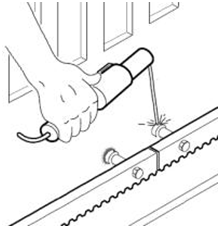
It is advisable to screw the spacers in the middle of the holes so that there is room for fine adjustments if needed later. As seen in the figure above, there is a wide side of the spacer (shoulder) which is welded onto the door. The main point of attention during rack installation is the small gap that must exist between the gear and the rack.

This gap helps in the proper operation of the door. If it is not present, the motor is forced to carry the door, so inevitably at some point it will wear out and cause a malfunction. If the gap is too large, the gear may "kick" and the door's movement may not be correct. In both cases, it is likely to create a problem either for the door or the motor.
The correct gap is around 1.5 mm. To achieve this, we can place the mechanism on a surface of this thickness and proceed with the installation of the rack in contact with the gear. Then, after removing this surface, the motor will lower by 1.5mm, so we will have the necessary gap.
During rack installation, the rack pieces should not be welded together, and their pitch must be maintained. Also, the rack should not be welded to the spacers. The following diagram shows exactly the procedure to be followed.

It is also necessary to ensure that the gear engages with the rack throughout its entire travel. If necessary, we can loosen the mechanism's support and move it perpendicular to the gate leaf to achieve the correct position.
The necessary check for correct rack installation is done by opening and closing the door at a steady speed. If the door moves smoothly without jolts, noises, etc., then the rack installation is correct. Then we can tighten the screws of the spacers and the motor mounting screws.
Important note: Before operating the mechanism electrically, we must first confirm the opening direction (that it is correct) and install the terminals.
 Next, the terminals included in the mechanism kit are installed. Under no circumstances should makeshift terminals be used or their shape modified, as this will cause the mechanism to malfunction. The terminals are placed at such a point as to activate the mechanism's limit switches. This is done by pushing the spring-loaded plunger of the mechanism in one direction or the other. Particular attention is required so that the gate stops 2cm before the final position, both in the open and closed positions. In this way, the gate will not hit any of the fixed points at the end of its travel.
- Check that the wiring in the panel is correct (the direction must be correct for left-right).
- Manually push the gate left and right and check that the corresponding LED for the open and closed positions turns off. Check that we have the correct distance (approximately 2cm) from the open and closed position stops, respectively.
Finally, it is essential to check the proper functioning of the entire installation. We check if the gate stops at the correct points, if the photocells are working, if the remote controls are working correctly, etc. It is advisable for the above checks to be carried out at least twice a year.
Then we hand over the remote controls to the users and inform everyone involved with the garage door (users and non-users) about its operation and points of attention during its use.
RIB K800 Sliding Gate Mechanism Gear
 The RIB K800 mechanism features a metal gear surrounded by a protective cover to prevent injuries.
Wiring of RIB K800 Sliding Gate Mechanism

The wiring of sliding mechanisms is a process that usually requires specialized personnel.
- The mechanism requires a 3x1.5mm² or 3x2.5mm² cable if the installation point of the automation is far from the control panel. (It is advisable for the mechanism to be on a separate fuse in the control panel)
- Wired photocells require a 4×0.6mm² cable for the receiver and a 2×0.6mm² cable for the transmitter. We usually place the receiver near the mechanism. If it is impossible to run a cable across for the photocells, we can install photocells with a reflector that require wiring only on one side.
- The warning lamp requires 1×1.0 mm² or 2×1.0 mm² wiring.
- The key switch or simple push button requires 2×0.6mm² wiring.
All cables must be protected from weather conditions (inside conduits).
Sliding Mechanism Control Panel

The Autotech S5060T control panel is included in the set and is integrated into the mechanism. It is a control panel that combines simplicity of use with all the necessary functions and has been tested over time. It works perfectly with the RIB K800 mechanism.
Technical specifications:
- It has a socket for the mechanism's limit switches.
- We can adjust the mechanism's force.
- It has the ability for soft start and stop to reduce wear on the mechanism and the garage door.
- It accepts safety photocells that stop movement when they detect an obstacle during door closing and initiate reverse movement (opening).
- There is an available setting for automatic door closing with user-selectable closing start time. Photocell use is essential for automatic closing operation.
- There is an option for electric braking.
- The opening direction is adjusted with a microswitch.
- The panel can accept a button (keypad or simple push-button).
- The panel can accept a 230VAC warning lamp without a flasher or a 230VAC lighting lamp.
- It has an integrated receiver with simple operation.
- User information regarding the mechanism's functions is provided by LED lights.
The above control panel has been tested by thousands of users and has proven to be extremely reliable. Furthermore, it features functions such as mechanism force adjustment, slow start and stop, which make it one of the best choices on the market today.
ProfelmNet PSD-36T Sliding Mechanism Remote Control

The ProfelmNet PSD-36T remote control has 4 buttons on which we can program 4 different mechanisms. It is a fixed 12-bit code at 433.92 MHz. It is easy to use, well-designed, and works perfectly with the Autotech S5060T control panel.
Packaging of the sliding gate mechanism kit
The set is delivered in two separate packages if it also includes a rack. The elongated package contains the metal rack. The second package contains the mechanism with all its accessories and peripherals.
Before delivery, our company's technical control department adjusts the remote controls and checks that the entire system is ready for installation.
Instructions for the sliding gate opener kit
The kit comes with easy-to-follow instructions in Greek, provided one has basic knowledge and "is handy". Basic knowledge required includes experience in arc welding and electrical work. Otherwise, it is advisable to call a specialized technician.
The instructions include detailed steps for installing the mechanism's base, the mechanism itself, the rack, as well as all accessories that a sliding kit may contain (photocells, remote controls, lamp, antenna, etc.).