

Motor for Motorline Professional LINCE 400 Swing Garage Doors


To the single or double leaf swing gate mechanism Motorline Professional LINCE 400, depending on your needs, you can add 1 to 4 remote controls and wired or reflector photocells. General information for the LINCE 400 left mechanism:
- Electromechanical mechanism with permanent lubrication
- Maximum leaf width (with electric lock): up to 3.0 m
- Maximum leaf width (without electric lock): up to 2.5 m
- Maximum number of operating cycles per hour: up to 21 at 20°C
- Maximum number of operating cycles per day: up to 30
- Piston stroke (useful): 40 cm
- Maximum force: 2300 N
- Single-phase motor. Motor operating voltage: 230 VAC
- Motor absorbed power: 180 W
- Motor winding thermal protection: 120 °C
- Manual operation with special hexagonal key
- Warranty: 2 years
To order this product and customize it to your needs, please call us at 210.555.0632 or buy it online from our e-shop.
LINCE 400 mechanism - Dimensions

The Motorline Professional LINCE 400 motors have convenient dimensions and an attractive design.
Visual inspections during the installation of a swing gate mechanism
The first point to check when installing a swing gate mechanism is whether there is space for the arm. We open the door 90o and observe if there is space behind it for the mechanism. If the door abuts a structural element or another obstacle (like the left leaf in the diagram below), then a mechanism cannot be installed without modifying the door or creating the appropriate space. (in this case, digging out the structural element and creating space for the motor)
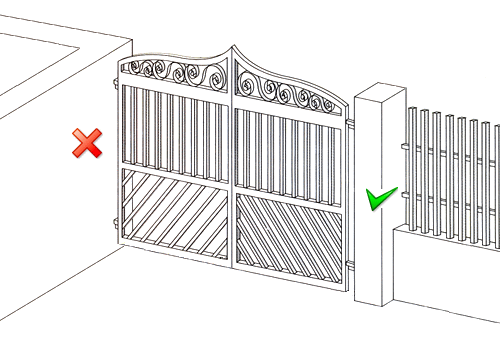
Depending on the user's needs, the gate can be open-type or closed-type. Open-type gates allow visibility and air passage, as they are usually designed with railings. In contrast, closed-type gates do not allow visibility to and from the area and, of course, wind passage. This often makes movement difficult, as wind pressure exerts great forces on the gate and consequently on the mechanism. Therefore, in areas where strong winds prevail, it is wrong to install a mechanism on a blind swing gate. In the best case, the gate will not function properly (it will partially close) when there is wind pressure, and there is a high probability that the mechanism will be damaged.
This point requires special attention, as no manufacturer's warranty covers damage caused by wind pressure. In many cases, we could have better gate behavior by installing a stronger mechanism and/or an electric lock. In most cases, however, our advice is not to install a swing mechanism on a blind gate unless it is protected from strong wind pressures. (e.g., in densely populated areas, if there is a tall building in front, etc.). A sketch of a single-leaf and double-leaf gate follows:


- It must operate correctly manually
- It must have a mechanical stop


Swing gate mechanism installation distances - Operating modes
Swing gate mechanisms can operate in 2 ways:
1st way: They pull the gate to open it and push it to close it. (opening inwards)
2nd way: They push the gate to open it and pull it to close it. (opening outwards)
The distances 'X' and 'Y' for the mounting position of the mechanism must comply with the tables and diagrams below for both installation methods.
1st way:

|
FOR 950 OPENING INWARDS |
X (in mm) |
Y (in mm) |
|
MECHANISM with 400mm stroke |
120 to 180 |
120 to 180 |
|
MECHANISM with 600mm stroke |
120 to 350 |
120 to 200 |
2nd way:

|
FOR 950 OPENING OUTWARDS |
X (in mm) |
Y (in mm) |
|
MECHANISM with 400mm stroke |
160 to 200 |
120 to 180 |
|
MECHANISM with 600mm stroke |
160 to 300 |
120 to 280 |
Single leaf swing garage door - wiring

- (1) The mechanism requires a 3x1.5mm² or 3x2.5mm² cable if the automation installation point is far from the control panel. (It is advisable for the mechanism to have a separate fuse on the control panel.) The cable must be waterproof and in a conduit with a diameter of at least Φ16. The length of cable left by the electrician should be sufficient (1.5m) to reach the location of the electronic control panel.
- (2) Wired photocells require a 4×0.6mm² cable for the receiver and a 2×0.6mm² cable for the transmitter. Usually, we install the receiver close to the mechanism and the panel. If it is not possible to run a cable across for the photocells, we can install reflector photocells which only require wiring on one side. (so line 2 is not required)
Notes:
- Single or double leaf gate requires one control panel.
- Heliflex type PVC flexible conduits are most suitable for this type of installation.
- Wiring must be protected and watertight to prevent short circuits, etc.
Double leaf swing garage door - wiring

- (1) The mechanism requires a 4x1.5mm² or 4x2.5mm² cable if the automation installation point is far from the control panel. (It is advisable for the mechanism to have a separate fuse on the control panel.) The cable must be waterproof and in a conduit with a diameter of at least Φ16. The length of cable left by the electrician should be sufficient (1.5m) to reach the location of the electronic control panel.
- (2) Wired photocells require a 4×0.6mm² cable for the receiver and a 2×0.6mm² cable for the transmitter. Usually, we install the receiver close to the mechanism and the panel. If it is not possible to run a cable across for the photocells, we can install reflector photocells which only require wiring on one side. (so line 2 is not required)
- (4) For push-button (or key-switch), a 2x0.5mm² cable is required (not included in the kit).
- (5) The remote control receiver requires a 3x0.5mm² cable (in our case, it is integrated into the panel).
- (6) The safety light requires a 2x1.5mm² cable (not included in the kit).
- (7) The electric lock requires a 2x1.5mm² cable (not included in the kit).
Notes:
- Single or double leaf gate requires one control panel.
- Heliflex type PVC flexible conduits are most suitable for this type of installation.
- Wiring must be protected and watertight to prevent short circuits, etc.
Remote controls for ProfelmNet PSD-36T swing mechanisms
You can add up to 5 ProfelmNet PSD-36T remote controls at 433.92 MHz to the swing gate mechanism kits (if you need more, please inform us by phone or email). The ProfelmNet PSD-36T remote controls are easy to use, practical, and functional. They can store up to 4 gates. They are fixed code 12-bit at 433.92 MHz. They can copy remote controls of the same type and older fixed code ones that operate at 433.92 MHz.

ProfelmNet PS-3114 control board for the Lince 400 mechanism

ProfelmNet PS-3114 control panel (with enclosure) for 230 VAC swing garage door motors. Suitable for single or double leaf gates.
- Single-phase motor (230 VAC).
- Operating frequency: 433.92 MHz.
- Integrated 433.92 MHz receiver with easy remote control registration.
- Encoding: Fixed
- Motor force adjustment.
- Slow motion adjustment.
- Automatic closing activation.
- Inputs for safety devices such as safety photocells (supports photocells for closing protection and photocells for closing and opening protection)
- Push button inputs for open/close command.
- Output for 230VAC warning light or lighting.
- Possibility of adding an electric lock.
- Easy travel time learning with learning of opening time, closing time, slow speed during opening, slow speed during closing for each motor separately.
- Diagnostic LEDs for the operating status of each motor.
- CE Compliance
Please note that electrical connections and travel programming must be done as described in the respective panel instructions to avoid problems during the mechanism's operation.
Detailed instructions for the ProfelmNet PS-3114 remote control panel
Manual operation of Lince 400 swing mechanism
Steps for manual operation of the swing mechanism:
Unclip the protective cover:

Check the special marking for the opening direction:


Detailed description of NOLOGO IR5001P / Zoom-Z2E wired photocells
- Operating voltage: 12 or 24 V DC, 12 or 24 V AC
- Maximum operating distance: 20m
- Maximum switch contact current: 0.5 A at 48 V AC/DC
- Transmitter operating current: 25 mA
- Receiver operating current: 35 mA
- Interference rejection circuit from other light sources
- Automatic focusing

Description of Witt Sensoric RP25 reflector safety photocells


- In addition to not requiring wiring, they also do not require batteries like other wireless photocells. This practically means that the user installs them and never has to deal with them again.
- The large reflective surface of the reflector makes their operation more reliable.
- The design of Witt Sensoric RP25 photocells is suitable for outdoor use, making them suitable for garage door applications.
- They have a range of 15m, making them suitable for most garage doors/gates.
- They are not interfered with by sunlight or other light sources because they operate with a polarized light filter. This means they can detect even reflective objects between the transceiver and the reflector, so they are not easily fooled by the polished surface of a car.
Technical specifications:
- CE marked
- Complies with EMC directive 89/336/EEC, EN 61000-6-2 and EN 61000-6-4 standards
- Operating voltage: 10-40 V DC or 24 V AC (±25%)
- Minimum operating distance: 0.5m
- Maximum operating distance: 15m
- Polarized light beam arrangement: excellent interference resistance
- Protection degree against dust and moisture: IP-67
- Easy cable installation. Features detachable terminal block - cable gland and elastic washer for waterproofing
- Protection against incorrect polarity power supply
- Beam direction is easily adjusted by 3 screws.
- Features a red-green LED for obstruction or operation detection (Red when obstructed - Green when clear)
- Immediate operation in less than 200 ms from the moment it is connected to power
- Maximum transceiver consumption: 30 mA at 24 V DC
- Maximum contact current: 0.3 A at 100 V AC, 0.5 A at 48 V DC
- Dimensions: 86x44x39 mm
- Beam range: approximately 1.5° total
- Response time: less than 10 ms from the moment the beam is interrupted
- Reset time: the contact returns to its normal state in less than 100 ms from the moment the beam interruption ceases
- Operating temperature: -25 to +60 °C
- Test input contact. When contact #1 is connected to 0 V (GND), the transmitter turns off.
Lince 400 Mechanism Installation Instructions
The set is delivered with instructions in Greek that are easy to follow, provided one has basic knowledge and is "handy". Otherwise, it is advisable to call a specialized technician.
The instructions include detailed steps for installing the mechanism base, the mechanism itself, and all accessories that an automatic gate set may include (photocells, remote controls, flashing light, antenna, etc.)
English instructions for the motor can be found at the following link: Lince 400 Mechanism Instructions EN