

VDS SL1600-OIL Sliding Gate Motor Kit (Standard) S
Drive unit set for sliding garage door. It includes a VDS SL1600-OIL motor, an integrated Autotech S5060T control panel, 4m metal rack, 2 ProfelmNet PSD-36T remote controls, and a set of wired safety photocells. Also included: base and mounting hardware, limit switch activation tabs, disengagement keys, installation instructions in Greek, etc. For gate weight up to 1600kg.
- For maximum gate leaf weight of 1600kg
- Non-reversible, in oil bath
- Up to 48 open/close cycles per hour (at 20°C)
- Up to 150 open/close cycles per day.
- Single-phase motor (230 VAC)
- Mechanism dimensions: 310x150x264 mm (LxWxH)
- Gate leaf speed: 10 m/min
- Motor absorbed power: 330 W
- Motor thermal protection: 140 °C
- Features a key-operated hatch for disengagement (manual operation)
- Protection degree: IP44
- Gear type is Z16/module 4
- Metal rack module 4
- Motor country of origin: Italy
- Warranty: 2 years
To order this product, call us at 210.555.0632 orbuy it online from our e-shop.
The VDS SL1600-OIL (kit-Standard) S set includes:

- VDS SL1600-OIL sliding garage door mechanism for 1600kg gate with all its accessories:
- Mechanism mounting base with screws and anchors
- Manual override keys (2 pcs)
- Limit switch activation tabs
- Detailed instructions written in Greek
- ProfelmNet PSD-36T remote control at 433.92 MHz, 2 pcs
- Metal rack, 4m
- Wired photocells, 1 set
The VDS SL1600-OIL (kit-Standard) S set is a set for installation on a garage door with all the necessary accessories. Other materials can be added to it depending on your needs
.
Criteria for installing the VDS SL1600-OIL mechanism on your gate
- It can be installed on a gate leaf with a maximum weight of 1600kg.
- It can be used up to 48 times per hour.
- It can be used up to 150 times per day.
1600kg of gate weight is a quite high limit assuming that the average weight of sliding courtyard gates is usually 60-70kg/m. However, if the gate's weight is unknown, it is advisable to ask the manufacturer. From our experience, the above mechanism covers most cases of sliding courtyard gates.
The 48 uses per hour cover most cases of apartment buildings, as the gate can operate almost every minute during peak hours. The motor has thermal protection. This means that in case of overuse and overheating, movement is interrupted until the normal temperature is restored. It is logical that smaller gates, in a cold environment, can perform more cycles than larger gates in a hot environment. If the motor stops due to overheating, the gate must be operated manually.
The uses per day can cover more than 35 cars that would use it 4 times per day. These uses (compared to the uses per hour) are the optimal operation for the mechanism to last for many years without problems.
Features and advantages of the VDS SL1600-OIL mechanism

- The VDS SL1600-OIL mechanism is built for intensive use. It can be used in apartment buildings or commercial premises with heavy traffic.
- Suitable for heavy sliding garage doors.
- Quiet during operation.
- Minimum maintenance requirements.
- Low price for an oil bath mechanism.
- Easy installation.
- Convenient dimensions:

The windings and mechanical parts of the VDS SL1600-OIL mechanism are immersed in an oil bath. This offers two significant advantages: better lubrication and better cooling.
Better lubrication is achieved because the entire mechanical part of the mechanism "swims" in the special oil.
Better cooling of the motor is achieved because the oil ensures that there is no single point that is extremely hot compared to the others, as the oil "wets" the entire interior of the motor, reducing both the risk of overheating and corresponding wear. It also absorbs the heat generated both by the mechanical operation of the motor and, primarily, by the electrical operation of the motor (the heat generated in the motor windings, which also "swim" in the oil) and transfers it uniformly to the motor's walls, which dissipate it into the environment, achieving extremely effective cooling.
The motor has a special screw that is tightened upon delivery to prevent oil leakage. This screw is located under the motor cover. After installing the motor, this screw must be loosened by 2 turns so that the oil reservoir (the sump) can "breathe." This is the oil breather screw.
For checking the oil level, the motor has an external indicator, making checking easy. This is a great advantage of the VDS SL1600-OIL motor, as there is no need to remove the cover for checking.

Sliding garage door with mechanism - Features

A classic sliding courtyard gate arrangement with a mechanism naturally includes the gate leaf, which has wheels at its bottom. The wheels must be well-maintained to avoid hindering the movement of the gate and the mechanism.
On the ground, the rail on which the wheels move is securely fixed. The rail must be straight, without bumps or deformations.
The gate leaf is held upright by the rollers. The rollers are positioned so that they are always in contact with the gate from the fully open to the fully closed position. They must be stable and not allow the gate to deviate from its path, but without hindering its movement. They are placed at the top of the gate and in the middle of its travel.
The last accessories (for a gate without a mechanism) are the mechanical stops of the gate. The stops define the gate's travel, i.e., the final position of the gate both when opening and closing.
To automate a gate leaf, we install a metal (or plastic) rack. The rack is a toothed bar that works with the motor's gear to transmit motion.
The motor is placed in the center of the gate's travel so that it always has contact with the gate. It has a gear that transmits motion from the mechanism to the gate via the rack.
Beyond the mechanism, an essential accessory for the safety of the entire structure is the safety photocells. Safety photocells are placed on either side of the opening and check if there is an obstacle in the gate's path. If an obstacle is detected during the gate's closing, the photocells signal the mechanism's control panel, and the gate's closing stops.
Also, for even greater safety, a safety beacon could be installed, which provides a visual signal when the gate is in operation. It is usually installed when the gate is adjacent to busy roads, roads with heavy traffic, and in areas where visibility is limited.
Finally, in cases where the range of the remote controls is not desirable, an external antenna can be installed to amplify the signal.
VDS SL1600-OIL Sliding Automation Base
The mechanism comes with a base specifically designed for proper and sturdy support. The sub-base should preferably be made of concrete to ensure that the mechanism will be properly supported.
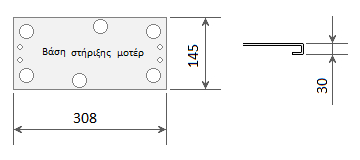
For the installation of the sliding mechanism base, we check the sub-base and the wiring. (the best solution is a reinforced concrete sub-base with coiled conduit for the wiring
Position of the VDS SL1600-OIL sliding automation base
The base of the sliding garage door mechanism must be placed at a specific point for the motor to function correctly. Below, the exact point where the base should be placed is detailed, depending on whether the door opens to the right or to the left. (left and right are defined as viewed from the side where the motor and rack are installed)


To find the correct base position, follow these steps:
- Manually push the gate leaf to the fully closed position. Place the mechanism's base on the ground, at a distance of at least B from the edge of the gate leaf.
- Manually push the gate leaf to the open position. The base must be at a distance C from the edge of the gate. If this is the case, proceed with the installation. If this condition is not met, there are 2 options:
- Compromise by not fully opening the gate leaf (but it will open until it reaches distance C from the base). Choose this solution if the free opening is sufficient and what remains still meets your needs.
- Lengthen the gate by extending the gate leaf. It can be lengthened along its entire height or only at the point where it contacts the rack.
Installation of mechanism (height) - Detailed dimensions
The installation height of the mechanism is extremely important for the entire installation process. What matters is the height in relation to the rack for their proper cooperation. Often, the gate's design determines where the rack will be placed so that there are attachment points for the rack on the gate. Below are detailed diagrams for the installation height of the mechanism in cases where the rack is installed with the teeth facing downwards (this is the recommended and most common solution).


H1= 30mm (motor mounting base height)
H2=90mm (base top to gear top)
H3=15mm (gear top to rack spacer axis)
H1+H2+H3=H1+H4+H5=135mm (base bottom to rack spacer axis)
H4=85mm (base top to rack bottom)
H5=20mm (rack bottom to rack spacer axis)
H6=10mm (spacer axis to rack top)
H1+H4=115mm (base bottom to rack bottom)
Ho= height of elevated foundation (the base can be placed in an elevated position for spatial reasons. In this case, the motor is protected, e.g., in case of a flood.
Based on the above dimensions, a preliminary check is performed before installing the mechanism. There are two cases:
- If a rack already exists, we check if the height at which it is already installed is suitable in relation to the mechanism's dimensions and the height at which its gear is placed. If the dimensions do not match, we will either have to raise the mechanism's base (if the rack is high) or change the rack's position (uninstall and reinstall).
- If there is no rack already, we check if there are available attachment points on the gate for the desired rack installation height. Otherwise, we will have to install the entire structure higher by modifying the sub-base where the mechanism's base will be placed.
A key point of attention is the clearance that must exist between the gear and the rack. Ideally, this clearance should be 1.5mm.

If this clearance is not present, the mechanism is forced to carry the gate along its entire travel instead of simply pushing it. This will cause wear and tear, and sooner or later, problems will arise in its operation.
Conversely, if the clearance is large, the cooperation between the gear and the rack will not be correct, and jerks and stresses will be created on the motor. Therefore, special attention is required to create this clearance.
Metal rack
The metal rack is delivered in one-meter pieces. It is galvanized for greater resistance to external conditions. The rack's cross-section is 12x30mm, the diametral pitch is 4 (module 4), and it has 3 spacers per piece. It can be installed on gate leaves with a maximum weight of 2 tons.

Autotech S5060T control panel for sliding garage door mechanisms

The Autotech S5060T control panel is included in the set and is integrated into the mechanism. It is a control panel that combines simplicity of use with all the necessary functions and has been tested over time. It is perfectly combined with the VDS SL1600-OIL mechanism.
Technical characteristics:
- It has a socket for the mechanism's limit switches
- We can adjust the mechanism's force.
- There is the possibility for soft start and stop for less wear and tear on the mechanism and the garage door.
- It accepts safety photocells that interrupt movement when they encounter an obstacle during the door's closing and initiate reverse movement (opening).
- There is an available setting for automatic closing of the door with the user choosing the closing start time. Photocell use is essential for automatic closing to function.
- There is the option of electric braking.
- The opening direction is adjusted with a microswitch.
- The panel can accept a push-button (keypad or simple push-button).
- The panel can accept a 230VAC warning light without a flasher or a 230VAC lighting lamp.
- It has a built-in receiver with simple operation.
- User information regarding the mechanism's functions is provided by LED lights.
The above control panel has been tested by thousands of users and has proven to be extremely reliable. In addition, it has features such as adjusting the mechanism's force, slow start and stop, which make it one of the best choices on the market today.
ProfelmNet PSD-36T remote controls at 433.92 MHz.
The ProfelmNet PSD-36T remote controls have an excellent design and are user-friendly and simple both in their use and programming. They have been tested by thousands of users and do not present problems. They can accept up to four commands from different mechanisms, which makes them convenient for users who have more than one automation in their daily use.

Sliding mechanism installation process - Briefly
In summary, the steps for installing a sliding garage door mechanism are as follows:
- Check that the door operates smoothly manually.
- Check the wiring if it exists, or install it.
- After the checks, the motor base is installed. It requires a stable sub-base. Usually, a reinforced concrete base is the appropriate solution.
- Installation of the motor on the base.
- Installation of the rack.
- Installation of accessories (if any)
The above are simply a summary of the steps for installing a sliding mechanism. Inside the mechanism's packaging, you will find detailed instructions, step-by-step, well-written and easy to follow.
Manual override for VDS SL1600-OIL sliding mechanism
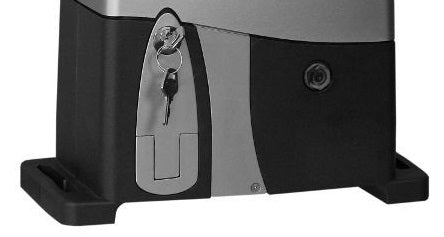
The manual override procedure for the VDS SL1600-OIL mechanism is a simple and easy process for all users. With the key, open the release door and push it to the fully open position. The garage door now operates manually. By reversing the procedure (closing and locking the door), we re-engage the mechanism.
Packaging of the VDS SL1600 OIL mechanism set (kit-Standard) S
The VDS Simply SL1600 set (kit-Economy) S is delivered in two packages. One contains the mechanism, the remote control, the photocells, and any accessories that may have been ordered extra with the set.
The second package contains only the metal rack due to its weight and length.
The set is delivered ready for installation as it has been checked by our technicians and the remote control is programmed.
Installation instructions for the sliding garage door set
The set comes with detailed instructions in Greek. They have been edited by us to be easy to follow even by people who are not directly involved in the subject.
They contain detailed steps for each stage of installation from the motor base and the rack to accessories such as photocells and buttons. Also included are detailed instructions for the Autotech S-5060T control panel which is integrated into the mechanism.