

Single-leaf swing garage door opener set MPC SW600 left (Kit-Standard 2114)
- Electromechanical mechanism with permanent lubrication
- Maximum door leaf width (with electric lock): up to 4.0 m
- Maximum door leaf width (without electric lock): up to 2.5 m
- Maximum number of operating cycles per hour: up to 21 at 20°C
- Maximum number of operating cycles per day: up to 30
- Piston stroke (useful): 60 cm
- Maximum force: 300 Kgf
- Single-phase motor. Motor operating voltage: 230 VAC
- Motor power consumption: 280 W
- Motor winding thermal protection: 150 °C
- Manual override with a special hexagonal key
- Warranty: 2 years
To order this product, call us at 210.555.0632 or buy it online from our eshop.
Contents of the MPC SW600 left kit (Kit-Economy 2114)

- MPC SW600 left mechanism
- ProfelmNet PS-2114N control panel installed in a waterproof box, 1 pc
- 2 ProfelmNet PSD-36T remote controls at 433.92 with 4 buttons
- 1 set of wired photocells
- All necessary accessories for the installation and operation of the mechanism (mounting bases and screws for the motor, capacitor, 1 release key and installation instructions)
Manufactured in Italy, it is tested and known for its reliability and durability.
The MPC SW400 mechanism can move door leaves with a width of up to 2.5m without an electric lock and with a width of 4.0m with the use of an electric lock.
The above set can be installed for the automation of a single-leaf swing garage door. Depending on your needs, products such as remote controls, photocells, etc. can be added to the set.
Installation of swing mechanism - Specifications
Installing a swing mechanism is a relatively simple matter, provided that due attention is paid to some specific dimensions. These dimensions are as follows:
- The width of the door leaf WL.
- The distances CL & DL. These dimensions are important when the mechanism is installed on the same side from which the door opens. (Conversely, when the door opens outwards and the mechanism is on the inside or vice versa, these dimensions do not play a role but the clear passage width is reduced)
- The maximum opening and closing cycles of the door per day and per hour.
- The design of the door. What interests us about the design is whether it allows air to pass through without resistance. That is, a barred gate is the best case, while a blind door without gaps is certainly a door that can face problems when strong winds prevail.
Our company is always ready to help you choose the right mechanism for your door. By phone or email, you can contact us and we will guide you in choosing the motor for your door. It is essential to know the above information, and in case of sending an email, photos of the door and the installation point of the mechanism would facilitate our choice.
Analysis of critical dimensions for selecting a swing mechanism
WL: width of the gate
CL: we open the door 90ο and measure the distance perpendicular to the door from a possible obstacle (structural element, tree, etc.)
DL: We measure perpendicular to the closed door the distance from the installation point of the mechanism base to the point where the door hinge is installed.

We measure the distances from the center of the hinge for greater accuracy:

Visual checks during swing mechanism installation
The first check point during the installation of a swing mechanism is whether there is space for the arm to be installed. We open the door 90ο and observe if there is space behind it for a mechanism. If the door abuts a structural element or another obstacle (such as the left leaf in the diagram below), then a mechanism cannot be installed without modifying the door or creating the appropriate space. (in this case, excavating the structural element and creating space for the motor)

Depending on the user's needs, the gate can be open-type or closed-type. Open-type gates allow visibility and air passage as they are usually made with bars. Conversely, closed-type gates do not allow visibility to and from the area and, of course, wind passage. This often makes movement difficult as wind pressure exerts great forces on the door and consequently on the mechanism. Therefore, in areas where strong winds prevail, it is wrong to install a mechanism on a blind swing gate. In the best case, the door will not function correctly (it will partially close) when there is wind pressure, and there is a high probability that the mechanism will be damaged.
This point requires particular attention as no manufacturer's warranty covers damages caused by wind pressure. In many cases, we could have better door performance by installing a stronger mechanism and/or an electric lock. In most cases, however, our advice is not to install a swing mechanism on a blind gate unless it is protected from strong wind pressures. (e.g., in densely populated areas, if there is a tall building in front, etc.)

Also, a basic prerequisite for installing a mechanism on a swing gate is that it operates perfectly manually and has mechanical stops.
Mechanical stops define the end of the door's travel in both the open and closed positions.

Installation distances for swing mechanism - Operating modes
Swing mechanisms can operate in 2 ways:
1st way: They pull the door to open it and push it to close it.
2nd way: They push the door to open it and pull it to close it.
The diagrams below analyze the operating method of a swing gate. The gate rotates around an axis (H) which is defined by its hinges (from their center).
The motor is supported by 2 articulations:
- The first is fixed and is the mounting point of the mechanism to the structural element. (P1)
- The second is movable and is the mounting point of the mechanism on the door. (P2)
These three points H, P1, P2 define a triangle with fixed sides H-P1 & H-P2 and one with variable length P1-P2. Depending on the installation method, the length P1-P2 increases when the door opens and decreases when it closes, or vice versa.
The distance from the center of rotation of the mechanism to the center of rotation of the door (H-P1) determines the operation of the mechanism. This is defined by the distances X and Y, which are clearly shown in the next diagram.
These distances are determined by the manufacturer of the mechanisms and must be observed during installation. A detailed table with these distances follows below.
Also, to determine point P2, we follow this procedure: In the first installation method, after we have defined point P1, we define point P2 at a distance Le where the piston is extended almost to the end of its stroke. In the second installation method, after we have again defined point P1, we define point P2 at a distance Lc where the piston is retracted almost to the limit of its stroke.
Detailed diagrams and tables follow, where S2 and S1 are the open and closed position stops respectively.
1st installation method for swing mechanism


This installation method is the most widespread and has the most advantages as it does not alter the design of the door, the mechanisms are indoors and thus protected, and the clear opening width remains the same as before the mechanism's installation. The only disadvantage is that specific spaces are required for the mechanism's installation.
2nd installation method for swing mechanism

This installation method is rarely used. The motor is placed between the opening and pushes the door to open it while pulling it to close it. It offers advantages, the most significant of which is the possibility of installation even when the necessary spaces required for the first installation method are not available. Also, the mechanism does not alter the appearance of the door and is inside, so it is protected. Disadvantages of this method are that it reduces the clear passage width and that the door opens outwards, so there is a risk to passers-by, etc.
Single-leaf swing garage door - wiring
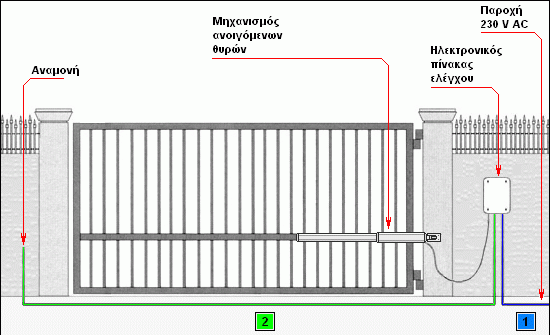
- (1) The mechanism requires a 3x1.5mm² or 3x2.5mm² cable if the distance of the automation installation point is far from the control panel. (it is advisable for the mechanism to be on a separate fuse in the control panel) The cable must be waterproof and in a conduit with a diameter of at least Φ16. The provision left by the electrician must be sufficient (1.5m) to reach the installation point of the electronic control panel.
- (2) Wired photocells require a 4×0.6mm² cable for the receiver and a 2×0.6mm² cable for the transmitter. Usually, we place the receiver near the mechanism and the panel. If it is impossible to run a cable across for the photocells, we can install photocells with a reflector, which only require wiring from one side. (so line 2 is not required)
Observations:
- Single or double leaf gate, requires one control panel.
- Heliflex type PVC flexible plastic pipes are most suitable for this type of installation.
- Wiring must be protected and watertight to prevent short circuits, etc.
Remote controls for ProfelmNet PSD-36T swing mechanisms

The ProfelmNet PSD-36T remote control has 4 buttons to which we can set 4 different mechanisms. It has a fixed 12-bit code at 433.92 MHz. It is easy to use, well-designed, and works perfectly with the control panels of swing mechanisms.
Wired photocells of the MPC SW600 left kit (Kit-Standard 2114)
Safety photocells are a product that prevents accidents and damage at a low cost. If there is an obstacle between the transmitter and the receiver, they prevent the door from closing, thus protecting pedestrians, vehicles, etc. If it is not possible to run cables to the opposite side, photocells with a reflector can be installed at a small extra cost.
Manual override of MPC SW600 swing mechanism
Insert the key into the slot as shown in the image and turn it clockwise.

The manual override process is complete. The door can now be moved by hand. By performing the reverse procedure, we return the mechanism to electrical operation.

Installation instructions for MPC SW600 mechanism
The kit comes with instructions in Greek which are easy to follow, provided one has basic knowledge and is "handy". Otherwise, it is advisable to call a specialized technician.
The instructions include detailed steps for installing the mechanism's base, the mechanism itself, as well as all accessories that a swing kit may contain (photocells, remote controls, beacon, antenna, etc.)